Choosing where — and how — your business will operate is one of the earliest decisions a company makes in the UAE, and one of the most consequential. For businesses setting up or expanding in Ajman, the choice usually comes down to two routes: signing a traditional commercial lease and building out your own office, or moving into a managed business center. Neither option is universally better. Each carries genuine advantages and genuine trade-offs, and the right answer depends on your size, your plans, and how much of your time you want to spend running an office rather than running a business.
What is a business center?
A business center is a professionally managed workspace environment in which the essentials of running an office are already in place. Instead of leasing an empty unit and fitting it out yourself, you move into a fully serviced office within a managed building — with reception and front-desk support, meeting and conference room access, high-speed internet, smart access systems, and daily facility maintenance handled by the operator.
The commercial arrangement reflects this. Rather than a long, rigid lease covering bare space alone, business centers typically offer flexible lease structures that bundle the workspace and its supporting services together. Options usually range from private cabins and dedicated offices to shared corporate spaces, with breakout areas and meeting room technology available across the facility.
The traditional lease route
A traditional office lease is the conventional path: you rent a commercial unit directly from a landlord, usually unfurnished, and typically for a fixed multi-year term. Everything inside the four walls then becomes your responsibility — the fit-out and furniture, internet and IT infrastructure, utility connections, cleaning contracts, ongoing maintenance, and any front-of-house staffing you need.
That responsibility is also the model's greatest strength. A traditional lease gives you complete control over your space. You can design the layout around your exact workflows, brand every surface, and configure security, storage, and technical infrastructure precisely as your operation demands. For organisations with specialised requirements or a strong, established identity, that level of customisation can be well worth the effort.
Comparing the two
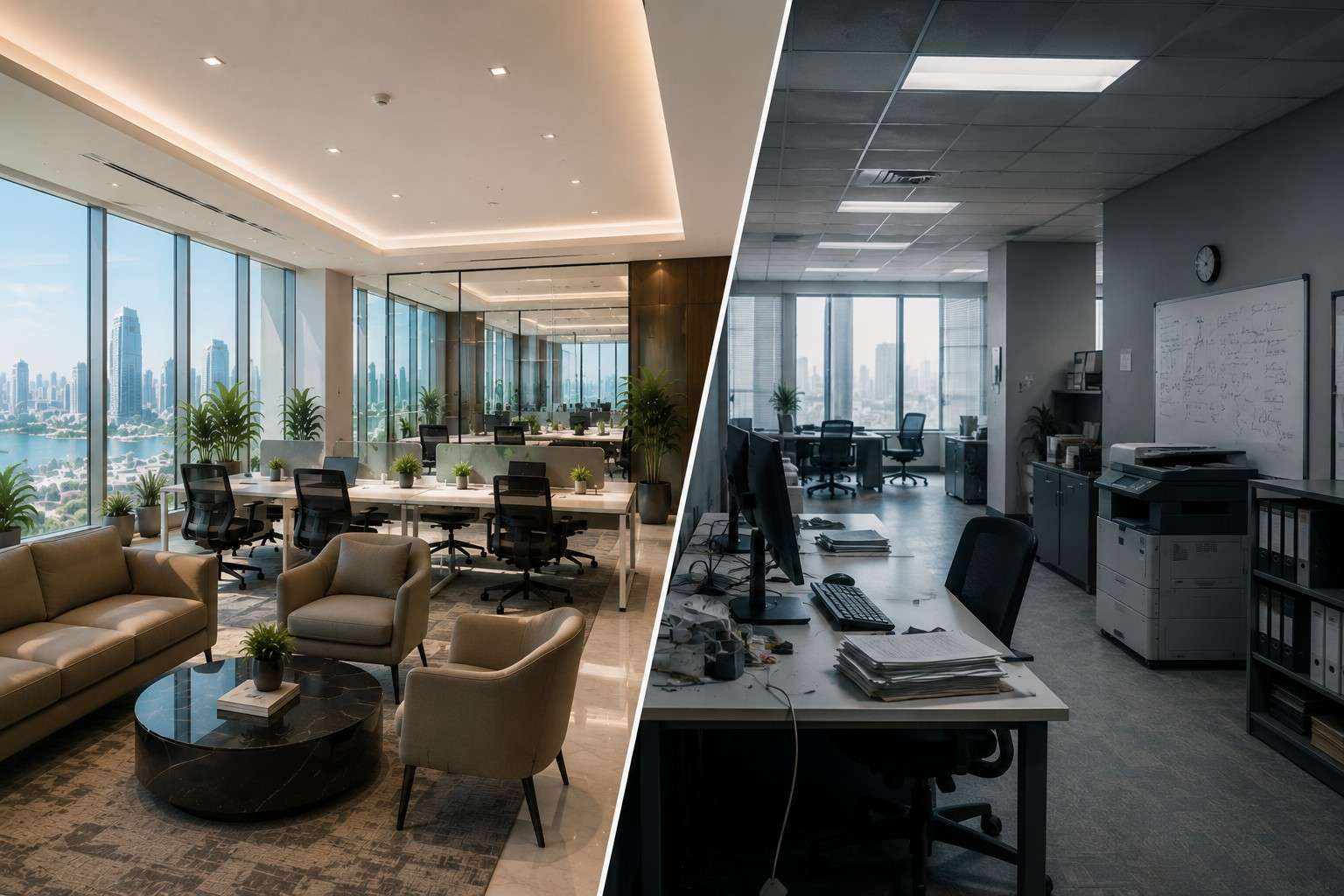
Setup time
With a traditional lease, there is a gap between signing and working. Design, fit-out approvals, contractor schedules, furniture delivery, and IT installation all sit between you and your first productive day — and delays in any one of them push everything back. A business center inverts this. The infrastructure is already built, connected, and maintained, so the time between deciding to move and actually operating is dramatically shorter. For a branch office entering the UAE or a startup that needs to begin trading, that speed is often the deciding factor.
Cost structure
The two models distribute cost very differently. A traditional lease pairs the rent itself with a chain of separate outlays: fit-out and furniture at the start, then utilities, connectivity, cleaning, maintenance, and staffing as ongoing line items — some predictable, some not. The early capital requirement can be significant, and it is spent before the office earns you anything. A business center consolidates most of these into a single, predictable arrangement. You are not funding a fit-out, procuring furniture, or negotiating with service vendors; the workspace, infrastructure, and support services come as one package. For businesses that value forecastable overheads, that predictability matters as much as the amount.
Flexibility & commitment
A multi-year lease is a commitment to a fixed amount of space, whatever happens to your headcount. Outgrow it and you face relocation or a second lease; contract, and you carry space you no longer need. Business centers are built around the opposite assumption — that businesses change. Flexible lease structures allow teams to scale up or down within the same building, moving between private offices and shared corporate spaces as their needs evolve, without the disruption of relocating operations.
Services & maintenance
Under a traditional lease, you become your own facilities manager: sourcing cleaners, arranging repairs, managing internet providers, and handling everything from access control to air conditioning. In a business center, these responsibilities sit with the operator. Reception and front-desk support, daily facility maintenance, 24/7 building support, and managed meeting room technology are part of the service — which means workplace problems are someone else's job to fix, and your team's attention stays on the work itself.
Professional image
Here the comparison is more nuanced. A traditional office lets you build a fully branded environment that is unmistakably yours — a real asset for large, established organisations receiving clients on their own terms. A business center offers a different kind of credibility: a professionally managed corporate environment, a staffed reception, and well-equipped meeting rooms from the very first day, allowing smaller teams to present themselves with a polish that would otherwise take years to build. The trade-off is less scope for brand customisation in shared areas, though private cabins and sound-conscious layouts still give teams a defined space of their own within the professional whole.
Which should you choose?
If your organisation is large, stable, and planning to stay put — with a settled headcount, a long operating horizon in Ajman, and requirements that genuinely demand a bespoke fit-out — a traditional lease deserves serious consideration. The control it offers is real, and for the right business the upfront investment pays back in a space shaped exactly to its needs.
If, on the other hand, you value speed, flexibility, and predictable costs — if you are launching, testing a market, opening a branch office, or simply unwilling to spend management time on facilities — a business center is usually the stronger fit. You start operating sooner, commit only to the space you need, and hand the operational burden of the office to a team whose job it is to carry it.
Many businesses also treat the two as stages rather than rivals: beginning in a business center while they establish themselves, and considering a traditional lease only once their scale and stability clearly justify it.
If you are weighing up the business center route, The Sandbox Workspaces Business Center — backed by FDI Zone Group Companies and located at Sky Tower on Sheikh Khalifa Bin Zayed Street, Al Nuaimia, Ajman, minutes from the routes connecting Ajman, Sharjah, and Dubai — offers fully serviced offices, shared corporate spaces, and meeting facilities under flexible lease structures. Explore our pricing and packages, or get in touch to arrange a visit and see the space for yourself.